

Introduction
Unsere moderne Welt ist geprägt von Stress, Umweltbelastungen und chronischen Beschwerden – viele Menschen suchen deshalb nach sanften, natürlichen Wegen zur Unterstützung ihrer körperlichen Regeneration und Entspannung. Ein faszinierender Ansatz ist das Endocannabinoid system (ECS) — ein körpereigenes Gesundheitssystem, das eine Schlüsselrolle bei Balance, Heilung und ganzheitlichem Wohlbefinden spielt.
In this article you will get the Endocannabinoid system einfach erklärt: Du erfährst, wie es funktioniert, wie du es bewusst aktivieren kannst, welche natürlichen Strategien helfen und welchen Platz CBD und andere Cannabinoids¹ can take it.
Even people who have never consumed cannabis or hemp possess an active Endocannabinoid system. It operates independently of external factors. Cannabinoids, since the body produces its own Endocannabinoids It produces plant substances such as THC or CBD, which can also affect this system and influence its activity.
1. What is it? Endocannabinoid system (ECS)?
Where it all began²: The Endocannabinoid system wurde Anfang der 1990er-Jahre entdeckt – durch die Erforschung der Wirkstoffe der Cannabispflanze. Es erhielt seinen Namen also nicht, weil es von Cannabis abhängig ist, sondern weil Cannabinoids played a central role in its discovery. This connection shows that our bodies and nature have always communicated with each other.
1. Building blocks of the ECS: Endocannabinoids, Receptors & Enzymes
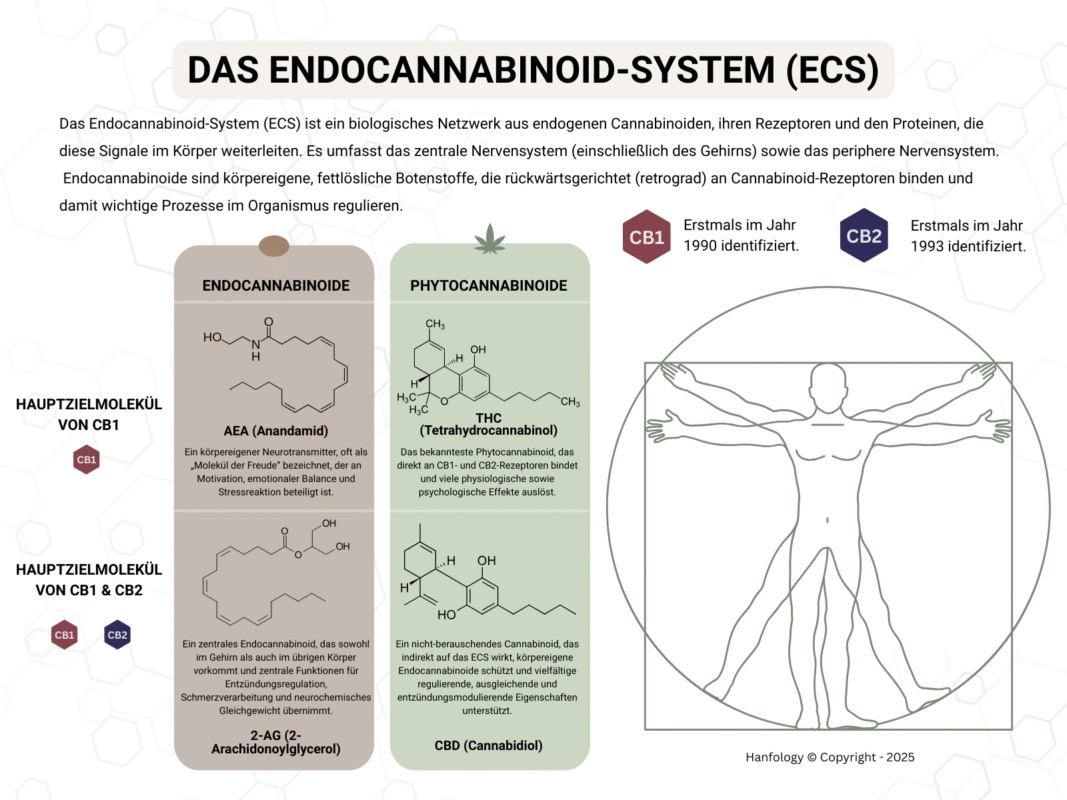
The Endocannabinoid system (ECS) is like an internal „rule system“ of your body that helps to maintain balance – similar to a thermostat that regulates the temperature in the room.
For this system to work, it needs three main components:
1.1 Endocannabinoids – the body's own messenger substances
Your body produces these substances itself – as needed. Some of the best-known include: Anandamide (also known as the "happy molecule" because it promotes well-being) or 2-AG.
You can Endocannabinoids Imagine messages or emails that are sent when something in the body needs to be regulated – such as pain, stress, inflammation, or even body temperature.
1.2 Receptors – the receivers for the messages
These "receiver stations" are located in many places in the body, especially:
- CB₁ receptors: in the brain, along the spinal column and in the nervous system (i.e., in everything related to thinking, pain perception or mood),
- CB₂ receptors are found in the immune system, in organs, and also in external body regions such as skin, bones, and peripheral nerves, where they influence, for example, inflammation. There, they play an important role in regulating healing processes. Imagine these receptors as door locks that can only be opened by the right keys (the endocannabinoids).
1.3 Enzyme – die „Aufräumer“ im System
Once the message has arrived and its effect has been achieved, certain enzymes come into play – especially FAAH and MAGL.
They build the Endocannabinoids They switch off quickly so they don't remain active for too long. Similar to a timer or a cleaning service that restores order after the job is done.
What is all this good for?
This health system helps your body regulate itself – in cases of stress, pain, sleep problems, or inflammation. It reacts flexibly as soon as something becomes unbalanced and brings you back into balance.
You can think of it as a built-in, intelligent feedback network – similar to a thermostat that notices when it's too hot or too cold and automatically adjusts accordingly. It intervenes to regulate when many parameters in the body become unbalanced.

1.4 Functions & Significance of the ECS
The Endocannabinoid system steuert und überwacht zahlreiche Prozesse, die mit Selbstheilung, Regeneration und innerer Balance in Verbindung stehen:
- Sleep & Wakefulness⁴
- Appetite & Digestion⁵
- Pain perception⁶
- Immune reactions & inflammation
- Mood, Stress response⁷ und Entspannung
- Cell protection & neuroprotection ⁸
If one of these functions malfunctions, the ECS⁹ regulierend ein, um Homöostase (inneres Gleichgewicht) zu sichern.
In short:
The Endocannabinoid system It acts like a silent communication network between body and mind – subtle, flexible, and highly intelligent. It's less of a switch and more of a regulator that gently brings your body back into balance time and again.
2. ECS & Self-Healing: How are they related?
2.1 ECS as a key to inner balance & healing
Self-healing10 means that your body is able to regenerate itself – from the smallest cell damage to the regulation of inflammation. Endocannabinoid system It supports this process by selectively amplifying or inhibiting signals that promote healing. This creates an internal environment in which regeneration becomes possible in the first place.
For example, the ECS controls the immune system's response to inflammatory processes — too much inflammation is harmful, but too little can hinder healing.
2.2 Hypothesis of clinical endocannabinoid deficiency (CECD¹¹)
Eine interessante Theorie ist die sogenannte klinische Endocannabinoid-Defizienz. Sie besagt, dass ein chronisch niedriger Spiegel an Endocannabinoiden mit Erkrankungen wie Migräne, Fibromyalgie oder Reizdarmsyndrom in Verbindung stehen könnte. Noch ist diese Theorie nicht bewiesen, aber sie liefert Denkansätze für neue Wege der Unterstützung von Selbstregulation und Homöostase.
A thought for you:
Vielleicht ist Heilung nicht immer ein Hinzufügen von etwas – sondern ein Wiederherstellen dessen, was dein Körper ohnehin schon weiß.

3. Natural strategies to support your ECS
3.1 Nutrition & Micronutrients
Sure, this isn't anything new – we all know that too much sugar and highly processed foods aren't good for our bodies. Nevertheless, it's worth remembering, because a simple, natural diet supports your Endocannabinoid system (ECS) jeden Tag auf natürliche Weise.
- Omega-3 fatty acids (e.g. in flaxseeds, chia seeds, walnuts) – they are the building blocks for Endocannabinoids.
- Antioxidants (e.g. in berries, turmeric, green tea) can reduce oxidative stress and thus relieve the ECS while simultaneously strengthening it.
- Phospholipids Lecithin (e.g., in sunflower seeds or egg yolks) helps your body to form important cell components – they are like small building blocks from which cells are made.
For a moment of reflection:
Ernährung ist mehr als Nährstoffzufuhr. Sie ist Kommunikation mit deinem Körper – täglich und wirkungsvoll. Eine gesunde Ernährung ist eine Basisstrategie für Selbstheilung und die Unterstützung deines Endocannabinoid-Systems.
3.2 Movement & physical activity
Regular exercise stimulates the Endocannabinoid system positive – especially aerobic exercise (e.g. brisk walking, jogging, cycling) as well as gentle methods such as yoga or Qi Gong. Studies¹² zeigen, dass moderate körperliche Aktivität die Endocannabinoid-Spiegel anheben kann und die körperliche Regeneration fördert. Besonders in Kombination mit Achtsamkeit hilft sie dabei, Stress abzubauen, die Selbstheilungskräfte zu aktivieren und emotionale wie physische Balance zu stärken.

3.3 Stress Management & Sleep Optimization
Chronic stress brings this Endocannabinoid system Out of sync. Meditation, breathing exercises, and mindful use of digital stimuli help restore your system's regulatory capacity. Good sleep further supports nighttime ECS activity, strengthens your self-healing abilities, and contributes significantly to emotional and physical balance.
3.4 The use of CBD (cannabidiol) as a supportive plant active ingredient
Today we know that your body has its own Cannabinoids bildet, um Balance und Wohlbefinden zu erhalten. Pflanzenstoffe wie CBD können diesen natürlichen Prozess sanft unterstützen – sie wirken wie ein freundlicher Anstoß, der dem Körper hilft, in sein Gleichgewicht zurückzufinden. So zeigt sich: Das ECS und die Cannabispflanze sind auf faszinierende Weise miteinander verwoben – Körperwissen und Pflanzenkraft im Dialog.
- Why CBD?
CBD is a Phytocannabinoid from the hemp plant, which has no intoxicating effect. - Mechanisms of action
CBD does not bind directly and strongly to CB₁ or CB₂, but modulates the Endocannabinoid system indirectly, e.g. by inhibiting enzyme activity, which Endocannabinoids dismantles. - Areas of influence
Studies and testimonials suggest that CBD Stress reduziert, die körperliche Regeneration unterstützt, Schlafqualität verbessert und Entspannung fördert.
Good to know:
Our body produces Endocannabinoids nur bei Bedarf – sie werden also ‚on demand‘ freigesetzt und danach rasch wieder abgebaut. Ihre Lebensdauer ist kurz, und genau hier setzt die Stärke von CBD an: Es kann dazu beitragen, dass diese körpereigenen Cannabinoids länger aktiv bleiben und so das Gleichgewicht des Endocannabinoid-Systems unterstützen. Das ist kein neues Prinzip, sondern zeigt einmal mehr, wie clever unser Körper und die Natur zusammenarbeiten.
In short:
CBD kann wie ein achtsamer Verstärker wirken – es verlängert das, was dein Körper ohnehin selbst tut, und fördert damit eine natürliche Homöostase und innere Selbstheilung.

4. Limits, Responsibilities & Uncertainties
CBD is not a miracle cure – but one option among many. It can effectively support your ECS, but it does not replace medical treatment.
Good to know:
- The proven "start low, go slow" method recommends: Begin with a low dose of CBD and increase it gradually – while carefully observing how your body reacts. If in doubt, consult a healthcare professional, especially if you are taking medication or are pregnant. CBD is not a substitute for medical care, but it can be a component of your personal recovery journey.
- Not everyone reacts the same way. Genetics, lifestyle, or microbiome can influence how your body reacts. Endocannabinoid system It works. Therefore, the same applies here: stay curious, examine critically – and listen to your body.
In Germany, CBD can be sold freely as long as it has a THC content of less than 0.2 % and no health claims are made.
Many scientific findings surrounding the Endocannabinoid system So far, research on hemp and CBD has come from animal studies or small-scale human trials. While the body of research is growing – over 4,000 scientific studies on hemp were published worldwide in 2024, which equates to roughly 11 new studies per day – the field remains dynamic and an open area of study.
5. Your practical self-healing plan with ECS focus
Hier ist ein beispielhafter Tagesplan, den du an deinen Alltag anpassen kannst, um Selbstheilung, körperliche Regeneration und Entspannung zu fördern:
| Time | Focus & Action | Why context is helpful |
|---|---|---|
| Tomorrow (after waking up) | Gentle stretching + 5 minutes of mindfulness or breathing exercise | Activates the Endocannabinoid system, mobilizes the body and brings calm to the system |
| Breakfast | Smoothie with Omega-3 (flaxseeds), berries, nut butter | Building blocks for Endocannabinoids delivery |
| Late morning | Light walk / exercise | Aktiviert das ECS, bringt Kreislauf in Schwung |
| Midday | Rich in color and antioxidants, moderate fat content | Unterstützt Entzündungsbalance und körperliche Regeneration |
| Afternoon (optional) | CBD-Anwendung (je nach Verträglichkeit & Absprache) | Unterstützt ECS‑Modulation und fördert Entspannung |
| Evening | Gentle movement, meditation |
Nicht vergessen:
It's not about living perfectly – but consciously. Small rituals, chosen honestly, can have a big impact and enhance your life. Endocannabinoid system Strengthen in the long term.
Conclusion & Outlook
Your Endocannabinoid system ist ein stiller Helfer im Hintergrund – ein feines Netzwerk, das Balance schafft, wenn du es unterstützt. Mit Ernährung, Bewegung, Achtsamkeit und ggf. CBD kannst du dieses System stärken und damit deine Fähigkeit zur Selbstheilung fördern. Ganz ohne Dogma – nur mit Vertrauen in deinen Körper und die natürliche Intelligenz der Homöostase.
Important: This information is not a substitute for medical diagnosis or treatment. Always consult a healthcare professional before embarking on any new path if you have pre-existing medical conditions, chronic illnesses, or are taking medication.
FAQs – Frequently Asked Questions
Yes. A healthy lifestyle with a balanced diet, sufficient exercise, good sleep, and targeted stress management strengthens the Endocannabinoid system Naturally. Plant-based active ingredients like CBD can also gently support it.
Our diet directly influences the Endocannabinoid system (ECS) – that is, the body's own network that is responsible for balance, stress regulation and well-being.
- Omega-3 fatty acids promote the formation of the body's own Endocannabinoids.
- Antioxidants protect the ECS from oxidative stress.
- One anti-inflammatory diet (e.g. with plenty of vegetables, healthy fats and little sugar) supports the function of the ECS – and thus also regeneration, mood and immune balance.
Food can therefore be a silent ally of your inner balance.
Movement brings your Endocannabinoid system (ECS) in motion.
- Even moderate activities such as Walking, jogging, strength training, yoga or Qigong promote the release of the body's own Endocannabinoids.
- These have a mood-lifting, pain-relieving and anti-inflammatory effect – completely naturally.
Exercise not only strengthens muscles, but also your inner balance and self-healing power.
CECD is a hypothesis that suggests persistently low endocannabinoid levels may be linked to chronic conditions such as migraines or irritable bowel syndrome. This model has not yet been definitively confirmed scientifically.
CBD (cannabidiol) indirectly affects the ECS. It can inhibit enzymes that are part of the body's own system. Endocannabinoids They break down, thus prolonging their effects. Many people report increased relaxation, better sleep, and faster recovery as a result.
No. Genetics, lifestyle, and environmental factors can influence the activity of the ECS. Age, stress levels, and diet also affect the body's self-regulation.
The endocannabinoid system (ECS) is a very finely regulated system. A healthy balance is crucial. Chronic stress, poor diet, or unhealthy habits can disrupt this balance. Therefore, gentle and mindful support is beneficial.
The ECS is a central element of self-regulation in the body. It acts as an interface between the nervous system, immune system and hormonal balance – and is therefore essential for holistic health, self-healing and physical regeneration.

Just wanted to drop a quick note to say how helpful this post was for my research. It is refreshing to read such a well written perspective that actually addresses the questions users have. I will definitely be coming back for more updates AI Pilot Review